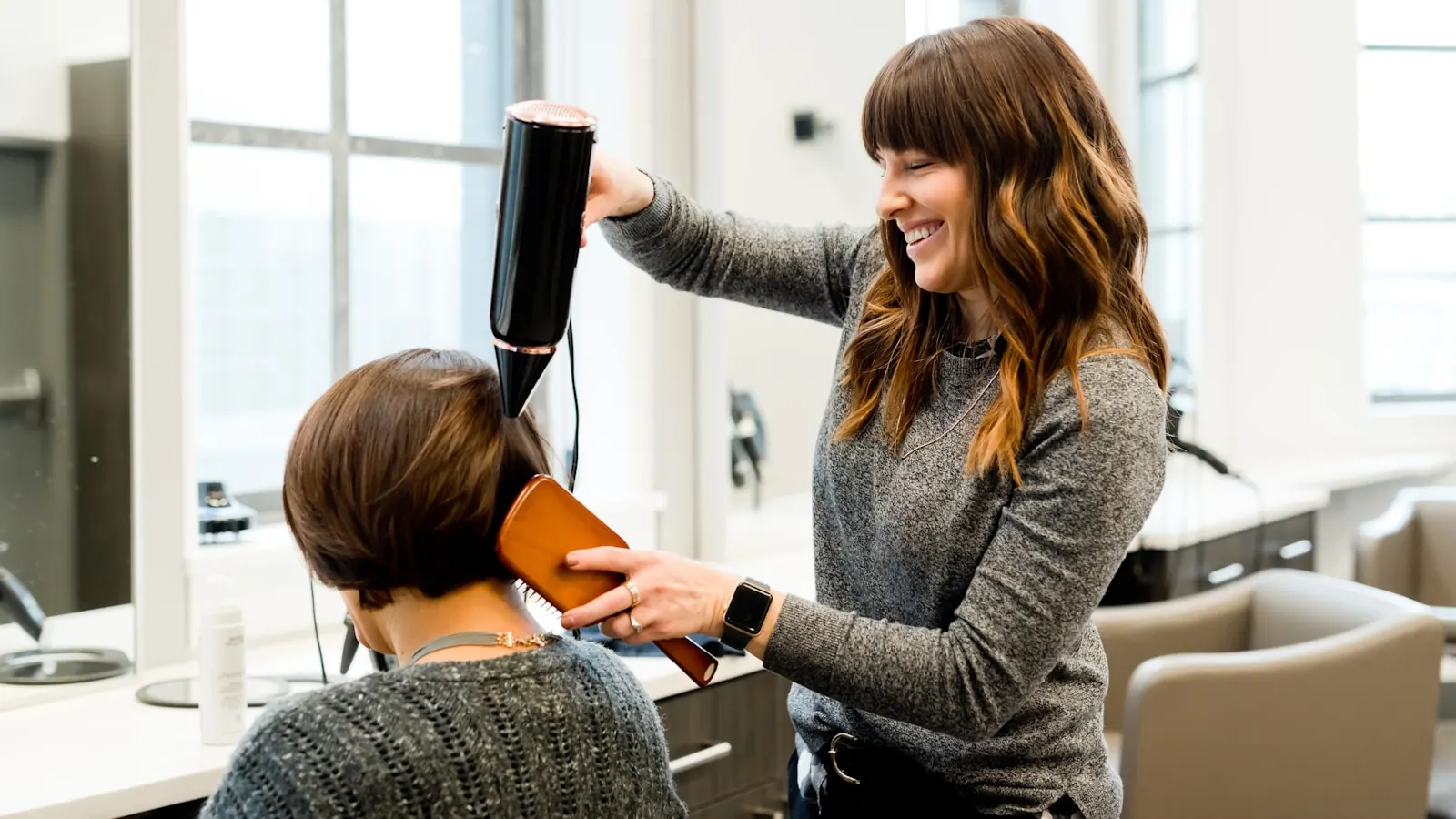
"How much does an independent hairdresser earn?" I see the question come up all the time. And every time, the answer stops at the price of a cut, as if that were the key variable. On the ground (I talk with about thirty Pépite Pass salon clients), it is exactly the opposite. Two salons at the same prices can have revenue that differs by a factor of two. The real variable is not in the price list.
I am not a hairdresser. I am the founder of Pépite Pass, a loyalty tool that salons use every day, and what I see going through the accounts is very clear: what drives an independent hairdresser's revenue is the visit frequency of their existing customers and the flow of new customers coming in, largely via Google.
Not the price of a cut. Price is marginal next to that.
This article is not a copy-paste of bogus numbers found on career-change websites. No precise take-home salary, no legal structures, no social contributions: that is not my job and I have no pretension of playing accountant. What I am going to give you is the equation I see working, and the two levers that the salons taking off really activate.
🧮 1. The real revenue equation for an independent hairdresser
When you look at a salon as an economic machine, the annual revenue boils down to:
Revenue = number of active customers × visit frequency × average spend
Three variables. Price is just one component of the average spend, and the most rigid one to act on. The other two variables (number of active customers and frequency) are massively more elastic. That is where everything is decided.
A quick illustration. Take two fictional salons at the same price:
- Salon A: 400 active customers, average frequency 4 visits/year, €55 spend. That is €88,000 in revenue.
- Salon B: 400 active customers, average frequency 6 visits/year, €55 spend. That is €132,000 in revenue.
Same price. Same number of customers. +50% revenue. The only difference is that Salon B's customers come back 2 weeks sooner on average.
👉 Two weeks. That is all.
And that is the elasticity I am talking about. Multiply that by an improved flow of new customers via Google reviews, and the gap becomes staggering.
The point of framing the equation like this is to make visible what was not. As long as you look at your salon through the lens of "is my cut priced well enough?", you do not see the 2 weeks of slippage; nor do you see the dormant customer who has not left for a competitor but is simply no longer on your mental radar. It is the lens that changes everything.
💸 2. Why raising your prices rarely works
When a hairdresser tells me "I am going to raise prices by €5, that will make up for it", I understand the intuition. Except there is a well-documented trap: the rebound effect. Not with everyone, but with a big enough slice to cancel out the gain.
- The customer spaces out their visits."Well, at that price, I will wait another week." You gain €5 per visit, but you lose 1 visit a year. On a €55 spend, it is a zero-sum game, if not negative.
- The customer tries the competition. When a price changes, some customers open Google and look at what is on offer 200 metres away. You become one option among many again instead of being the habit.
- The customer grumbles, your energy drops. It is more subtle, but real: when 3 customers in a row comment on the price, you feel it, and it weighs on the relationship.
I am not saying you should never raise your prices. Inflation exists, and aligning your prices with the cost of living is healthy. I am just saying that relying on price rises as your main engine of growth is a trap. The real levers are elsewhere.
🔁 3. Variable no. 1: frequency, getting the customer back a month sooner
It is by far the most profitable lever an independent salon has. And yet it is the one people work on least because it is invisible: your customers come back anyway, so you do not see the lost earnings.
Here are those lost earnings. A "monthly" customer who slips to "every 6 weeks" without anyone noticing is 4 visits/year lost. On a €50 spend, that is €200 of revenue evaporated per customer.
Run that across 300 regular customers: €60,000 that never reaches the till. Not because they left for a competitor, they just mentally moved on to something else for 2 weeks.
Why does it slip, almost always?
- The customer did not book their next appointment at the counter ("I will call you to sort out a slot"). They forget for 4 days, then 10, then 3 weeks.
- There is no structural reminder when the natural due date approaches. No text, no push, nothing. The salon waits passively.
- The customer does not have your card on their phone: you have no direct channel to tell them "hey, it has been 5 weeks, shall we book an appointment?".
The only scalable way to recover those 2-3 weeks of slippage is an automatic reminder at the right timing: short, personal, not salesy. On Pépite Pass salons, that is exactly what the Apple/Google Wallet loyalty card does: 4 to 6 weeks after the last visit, the customer receives a native notification ("It has been a month, shall we book a slot?").
Not an app to open, not a text lost among promotions, an iOS/Android push read on average 60 to 70% of the time. We covered this in more detail in the article on wallet push notifications.
⭐ 4. Variable no. 2: Google reviews, the machine that brings in fresh blood
The other half of the equation is the number of active customers. You can have the best frequency in the world, but if your customer base melts away every year (people moving, boredom, life events), you have to replace it. And for an independent hairdresser, almost all acquisition happens on Google.
Someone looking for a hairdresser in Paris's 11th or in Bordeaux Caudéran types "hairdresser + neighbourhood" into Google. They see the Map Pack (the 3 Google Maps listings pushed to the top), they look at the stars, they read 2-3 reviews, they call or they click.
If you are not in the Map Pack, you do not exist. 💀
And what determines the Map Pack, locally, is mainly:
- The number of Google reviews (not just the rating). A salon at 4.9 with 35 reviews almost always loses to a salon at 4.7 with 280 reviews.
- How recent the reviews are. Google gives more weight to recent reviews, that is what proves the salon is still active and appreciated.
- The consistency of the keywords in the reviews (colour, balayage, blow-dry, beard…), which signal to the algorithm what you actually do.
Conclusion: for an independent hairdresser, collecting lots of recent, qualified Google reviews is the cheapest acquisition lever on the market. No Facebook ads, no Instagram Ads, just a steady flow of genuine reviews that pushes your listing to the top.
Except that asking for a review by word of mouth almost never works. The customer says yes politely, leaves the salon, forgets. Out of 50 satisfied customers, you might collect 2 or 3 reviews with constant effort. That is why serious salons go through a dedicated mechanism.
On Pépite Pass, we use a prize wheel: at the end of the service, the customer scans a QR code, spins the wheel, tries for a small discount on their next colour or a free treatment, and the tool follows up with a qualified Google review request. Legal (no bought or conditional reviews), just a request at the right moment, on the right feeling.
The numbers I see on equipped salons: going from 2-3 reviews a month to 25-40 reviews a month, over 3 to 6 months. After a year, the local ranking is transformed.
What I find particularly interesting about this lever is that it is cumulative ✨. Every review collected stays visible for years, keeps weighing on the ranking, keeps reassuring prospects.
It is the opposite of advertising, which switches off the moment you cut the budget. For an independent hairdresser who wants to build durable acquisition without a big marketing budget, this is probably the project to launch first.
See how the Google review wheel works on Pépite Pass
🤝 5. Rebooking at the counter: the key moment 80% of salons miss
Even before any tooling, there is a manual habit that changes everything and that most independent salons do not do systematically: booking the next appointment at the point of payment.
The 90 seconds between "there you go, all done" and "see you soon" are the only moment when the customer has your price in hand, your availability in front of them, and their diary within reach. If they leave without an appointment booked, you have just lost 70% of the probability that they come back in the optimal window.
Three phrasings that work at the counter:
- "To keep your colour looking perfect, let us see each other again in 5 weeks, shall I suggest a slot?" You steer, you decide.
- "Shall I put you down for 12 June, same time? If anything changes, we sort it out over WhatsApp." The customer knows they can move it, so they say yes more easily.
- "I will send you a reminder 2 days before, as usual." You take away the mental load of having to remember.
On the salons I see, simply going from rebooking 30% of customers to 60% of customers radically changes the average annual frequency. No tool needed, just discipline.
The tool comes afterwards, to scale it: the wallet card automatically reminds the customer of their appointment 24h before (no-show effect cut in half) and triggers a rebooking push if the customer has not booked a slot and the optimal window is approaching. For the detailed mechanics on the salon side, see the article loyalty programme for hairdressers and beauty salons.
😴 6. The forgotten lever: customers who have not set foot in the salon for 3 months
Last point, the one that always surprises people when I mention it over WhatsApp with an owner. Every salon has a dormant stock: customers who used to come regularly and who have slipped away for 3 to 6 months. Not officially gone, just lost in life.
This stock represents 30 to 50% of the total customer base in many salons.
Without a tool, you have no way to identify them or reach back out. You do not have their up-to-date number, or the date of their last visit, or the ability to message them at scale. They slowly drift out of your sight and rarely come back on their own.
With a digital loyalty card, the scenario changes:
- Filter "customers with no visit in 90 days, previously regular".
- Targeted wallet push: "It has been a while since we saw you! Here, €15 off your next colour, to use before the end of June."
- Track the 30-day return rate. On equipped salons, you typically recover 10 to 20% of the targeted segment.
10 to 20% of dormant customers brought back, out of 200 dormant ones, is 20 to 40 customers who return and who, if they find their bearings again, slot back into the salon's normal frequency. It is probably the campaign with the best return on investment an independent hairdresser can activate. For the detail of the mechanics on the programme side, I wrote a whole article on loyalty programme mechanics that transpose almost as-is to a salon.
📊 7. Summary table: where to put your energy
To give you a visual reference, here is how I rank the levers, from least effective to most effective, for an independent hairdresser who wants to raise their revenue without turning everything upside down.
| Lever | Revenue impact | Effort | Risk |
|---|---|---|---|
| Price rise (+€5) | Low to neutral | Low | High rebound effect |
| Upsell on treatment/product | Moderate | Medium | Low |
| Rebooking at the counter | High | Low | None |
| Frequency reminder push (wallet) | Very high | Very low | None |
| Winning back dormant customers | Very high | Low | None |
| Massive Google reviews (wheel) | Very high long term | Low | None if done by the rules |
You will notice what is not in this table: paid advertising, daily Instagram, TikTok videos. These are bonuses, not foundations. The foundations are frequency and organic Google acquisition.
💡 8. If I had to sum it up in one sentence for an independent hairdresser
Your revenue is not driven by your prices. It is driven by how regularly your customers come back and by the flow of Google reviews that brings in new ones.
You adjust the price once every 18-24 months and that is that. The two real variables, on the other hand, are worked on every week. And that is precisely where a well-designed loyalty tool makes a difference, because it automates what cannot be done by hand: the reminder at the right timing, the win-back of dormant customers, the Google review request at the right moment.
I am not a hairdresser. I am not going to give you advice on your balayage technique or on choosing a hydraulic chair. But on the retention and acquisition mechanics of an independent salon in 2026, we have seen enough at Pépite Pass to know where the levers are, and where the dead ends are.
If you want to dig into your specific case (men's cut, colour, barbershop, mixed beauty salon), send me a WhatsApp message. I do not sell anything in the conversation, I just tell you which levers you probably have the most room to gain on.
Léo, founder of Pépite Pass.