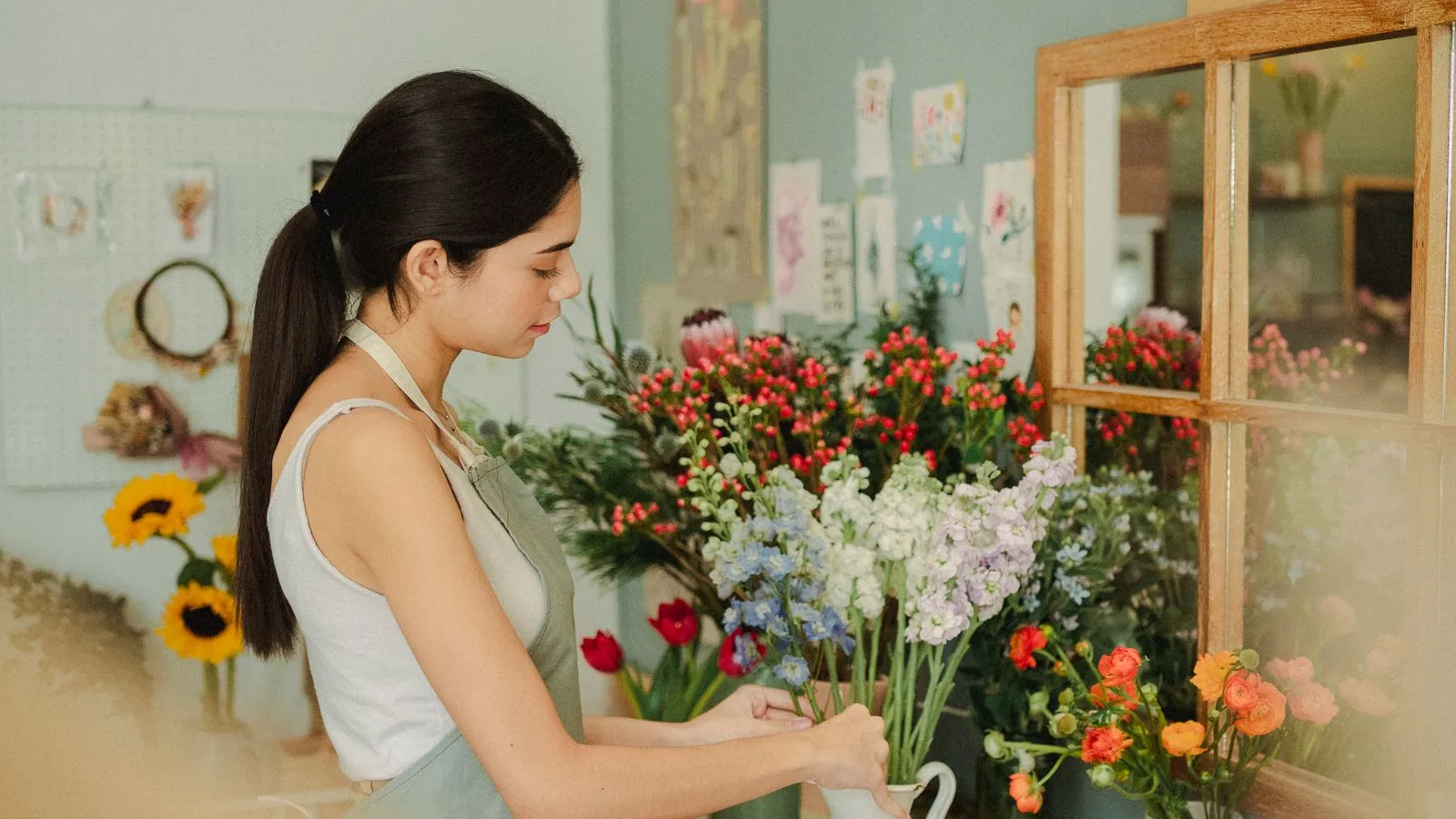
A florist is not a business short of customers. It is a business that lives off four or five frantic days a year and long weeks where the shop barely breathes.
Valentine's Day, Mother's Day, All Saints' Day, Christmas, perhaps May Day: those peaks make up a huge share of your turnover. And in between, it is silence.
A florist's real problem is not attracting more people at the peaks. It is bringing those people back between the peaks.
My name is Léo, I run Pépite Pass. We operate Apple Wallet and Google Wallet loyalty cards for local businesses all over France, florists among them.
And the pattern I see with them is so clear it deserves a whole article: on Mother's Day, dozens of people file through your shop whom you will probably never see again.
Not because they did not like it. Because nothing, absolutely nothing, brings them back to you the rest of the year.
This article is not a floristry lesson, I have no standing there and there are people far better placed than me to talk to you about floral foam and spirals. My subject is what turns a one-off bouquet buyer into a customer who thinks of you for their next birthday, their next dinner, their next thank-you. And on that, I do have concrete things to say.
📉 1. The florist's real problem: seasonality, not footfall
When a florist gets in touch, they often talk to me about visibility, competition, the supermarket next door slashing prices. Real issues. But when you look at their figures, the picture is always the same: a handful of days that explode, and a flat curve, sometimes very low, the rest of the year.
This is not an anomaly of your shop, it is the very nature of the trade. A flower is a product of emotion and occasion. You do not buy a bouquet the way you buy your bread: you buy it because something is happening. A birthday, a death, an apology, a birth, a date on the calendar.
The trap is not this seasonality, which is structural and which you will never remove. The trap is believing the answer is to push even harder on peak days, when the real opportunity lies elsewhere.
The opportunity is the sheer number of customers you cross paths with once and lose straight away. Do the quick mental sum: how many different people come through your door on a Mother's Day? And of those, how many come back on their own in July? The answer, for most of the florists I work with, is: a tiny minority. The whole job is to raise that figure, not to cram in even more people on the big day.
🚶 2. A bouquet buyer does not come back on their own
Here is the truth nobody tells florists.
👉 A satisfied customer is not a loyal customer.
Someone can love their bouquet, congratulate you, leave delighted, and never come back. Not for lack of desire. For lack of occasion and reminder.
In a café, the customer comes back on their own because their day has a rhythm: they walk past every morning, they crave their coffee at 8am.
At a florist's, there is no rhythm. Between two occasions to give flowers, three months, six months can go by. And during those months, you vanish from their mind. 💀
When the occasion comes round again, there is a one in three chance they think of you, a one in three chance they go to the florist nearest wherever they happen to be, and a one in three chance they grab a bouquet at the supermarket while doing their shopping.
In other words: the quality of your bouquets decides whether they are happy. It does not decide whether they come back. What decides the return is the existence of a link between you and them, and a reminder at the right moment. Without that link, your best Mother's Day customer is a stranger the moment they turn the corner. It is exactly the same logic I describe for the chocolate shop that has to survive between Christmas and Easter: a seasonal gift product makes the customer reminder more vital than elsewhere, not less.
📊 3. Loyalty is not a gimmick, it is how you smooth out your turnover
Many florists see the loyalty card as a nice little extra, a discount in disguise. That is missing the point entirely. For a business as seasonal as yours, loyalty is not a marketing gimmick: it is the only lever that can smooth out your turnover between the peaks.
Look at the mechanism more closely. On a peak day, you have two things at once: a huge flow of customers, and a shop already full of positive emotion. It is the ideal moment to create the link, because the customer is right there, in front of you, happy. If you capture them at that moment (their loyalty card in their phone), you keep a channel to them for the twelve months that follow. If you do not capture them, you lose them.
Then, between the peaks, that channel becomes your smoothing tool. A notification when you receive beautiful seasonal peonies. A reminder a few days before a birthday the customer told you about. A word for Grandmothers' Day, the back-to-school period, a local event.
Each reminder brings a few customers back on a Tuesday in March when, without it, the shop would have been empty. It is not spectacular.
But added up over the year, bringing back ten or fifteen customers a week during the quiet spells is often the difference between cash flow that holds and cash flow that plunges.
On the choice of the mechanic itself (points, stamps or a cashback pot), I laid out the reasoning in this article on the loyalty programme mechanics that actually work. For a florist, with very irregular baskets, the cashback pot is often the fairest: it rewards the big wedding basket just as much as the small treat bouquet, without penalising anyone.
🎯 4. The decisive moment: capturing the customer during the rush
If you were to take just one idea from this article, it would be this one. Peak days are both your biggest opportunity and your biggest waste. The biggest waste, because you watch dozens of buyers go by whom you will not see again. The biggest opportunity, because those people are already in your shop, already happy, already paying. You do not have to attract them: they are here.
The habit to build is very simple: turn every peak-day visit into a contact you keep. Concretely:
- A QR code visible at the till and in the window. While you wrap the bouquet, the customer scans and adds their card in a few seconds. No form, no typing on your side, no queue building up.
- The same QR on the bag, on the receipt, or on a small card tucked into the bouquet, so those in a hurry can add it quietly once they are back home.
- A simple line to say in passing: add our card, we will let you know when the beautiful seasons arrive and we set aside a reward for you with each purchase. That is it. No pitch, no waffle.
The whole point of the card in the Wallet is precisely that it requires no installation. The customer does not have to download an app, create an account or set a password: the card adds to Apple Wallet or Google Wallet in one tap, like a boarding pass. That is what makes the whole thing realistic on a Valentine's Day when you have fifteen people waiting: the gesture takes the customer three seconds and you zero. If you want to dig into why going app-free changes everything, I wrote an article about it: a loyalty card with no app.
See how the card adds in one tap, no app
🎂 5. Send reminders on personal occasions, not just the calendar
Here is the mistake I see with almost every florist who already has a customer file: they only communicate around calendar holidays. A promo for Mother's Day, an email for Valentine's Day, and that is it. Except on those days everyone is already thinking about it, you and your competitors alike. You speak loudest at the very moment the customer is most solicited.
The real opportunity is the customer's personal occasions. The ones the calendar does not mark, but which are a thousand times more powerful because nobody else pays them any attention:
- Birthdays. Theirs, their partner's, their parents'. If the customer gave you a date, a reminder three days before (shall we put something together for your wife's birthday?) captures a sale that would otherwise have gone through in a last-minute rush, or not at all.
- Recurring dates. A customer who ordered funeral flowers last year at the same time may be going through a painful anniversary: a discreet gesture at the right moment leaves a deep mark.
- Seasonal arrivals. The arrival of the peonies, the ranunculus, the first tulips. A simple notification saying we have just received these, they are stunning ✨, is enough to trigger a treat purchase with no calendar occasion at all.
- The dormant customer. The one you have not seen for three or four months. A short word, no aggressive promo, just to remind them you exist, and they come back in.
All of this rests on one thing: a direct, free contact channel, and a console that lets you see your customers, their dates and when they last came back.
When the card is in the Wallet, these reminders go through push notifications on the lock screen. They are free and unlimited, unlike SMS which costs a few cents to send.
That changes everything: the marginal cost of a customer reminder becomes zero, so you can afford to send reminders often and precisely, without ever watching a meter.
💸 6. The hidden cost of the customer you let slip away
In local retail we often reason backwards: we count what a tool costs, never what a lost customer costs. Yet it is the second figure that should keep you up at night.
Take a customer who, if you capture their occasions, would buy four bouquets from you over the year at a reasonable average basket, plus perhaps a big order for an event. That customer, over three years, is several hundred euros.
Now count all the ones you cross paths with at a peak and lose for lack of a link: you are not losing one bouquet, you are losing years of relationship. Multiplied by the number of people who file through on a holiday, the total is dizzying.
I laid out this lost-revenue logic in the article on how much a lost customer really costs: it is written for restaurants, but the reasoning is exactly the same for a florist, and even stronger given your baskets.
Against that, the cost of a digital loyalty card is negligible. With us, it is less than the price of a coffee a day, with no set-up fees, no per-customer fees, no tiers. The trial is free, with no bank card. If a single well-placed reminder brings back a handful of customers within the month, the subscription has paid for itself. The rest is turnover that would have gone elsewhere.
✅ 7. What I concretely advise a florist just starting out
If you want to get going without overcomplicating your life, here is the order I give:
- Choose the cashback pot as your base mechanic. It fits your irregular baskets and stays clear for the customer: a percentage of each purchase set aside, found again on the next visit.
- Put the QR code everywhere before your next big peak. At the till, in the window, on the bags. The till-display kit exists precisely for this, you print it and it is ready.
- Capture without blocking the queue. On the peak day, the goal is not for everyone to add the card, it is to capture as many as possible without slowing down service. A line, a scan, on to the next.
- Note the key dates of regular customers as soon as you can. Birthdays, recurring occasions. This is what will feed your personal reminders later.
- Schedule a first reminder in the month following the peak. A seasonal arrival, a simple word. You will see people come back, and you will understand the mechanism straight away.
The guiding principle behind all this, I always sum it up the same way: stick to the simplest solution that solves the real problem. Your real problem is not a lack of sophisticated marketing channels, it is a link that breaks the moment someone leaves the shop. A card in the phone and a few well-judged reminders are enough to repair it. The same seasonality logic applies to other food and craft trades: if the topic speaks to you, the article on the coffee roaster torn between a subscription and cashback loyalty digs into the same kind of trade-off.
📝 8. If I had to sum it up in one sentence
👉 A florist does not earn their survival at the peaks: they earn it between the peaks.
Valentine's Day and Mother's Day fill the till, but they also fill your shop with people you will never see again if you do nothing.
The work is not to sell more on those days. It is to capture those people while they are in front of you, happy, and to keep a link with them so you can bring them back on a Tuesday in March when the shop would have been empty.
That link hangs on very little: a loyalty card in their phone, captured at the right moment, and a few reminders timed to their own occasions and not just the calendar. It is simple, it costs less than a single lost customer, and it is what makes the difference between a florist who endures their seasonality and a florist who smooths it out.
If you want to talk it through concretely for your shop, write to me on WhatsApp at +33 6 03 90 27 83 or see what it looks like on the digital loyalty card page. I will not sell you a miracle solution, I will tell you what I see working for the florists we support. It is free, it is no commitment, and it will probably save you from losing another year of customers with every big day.