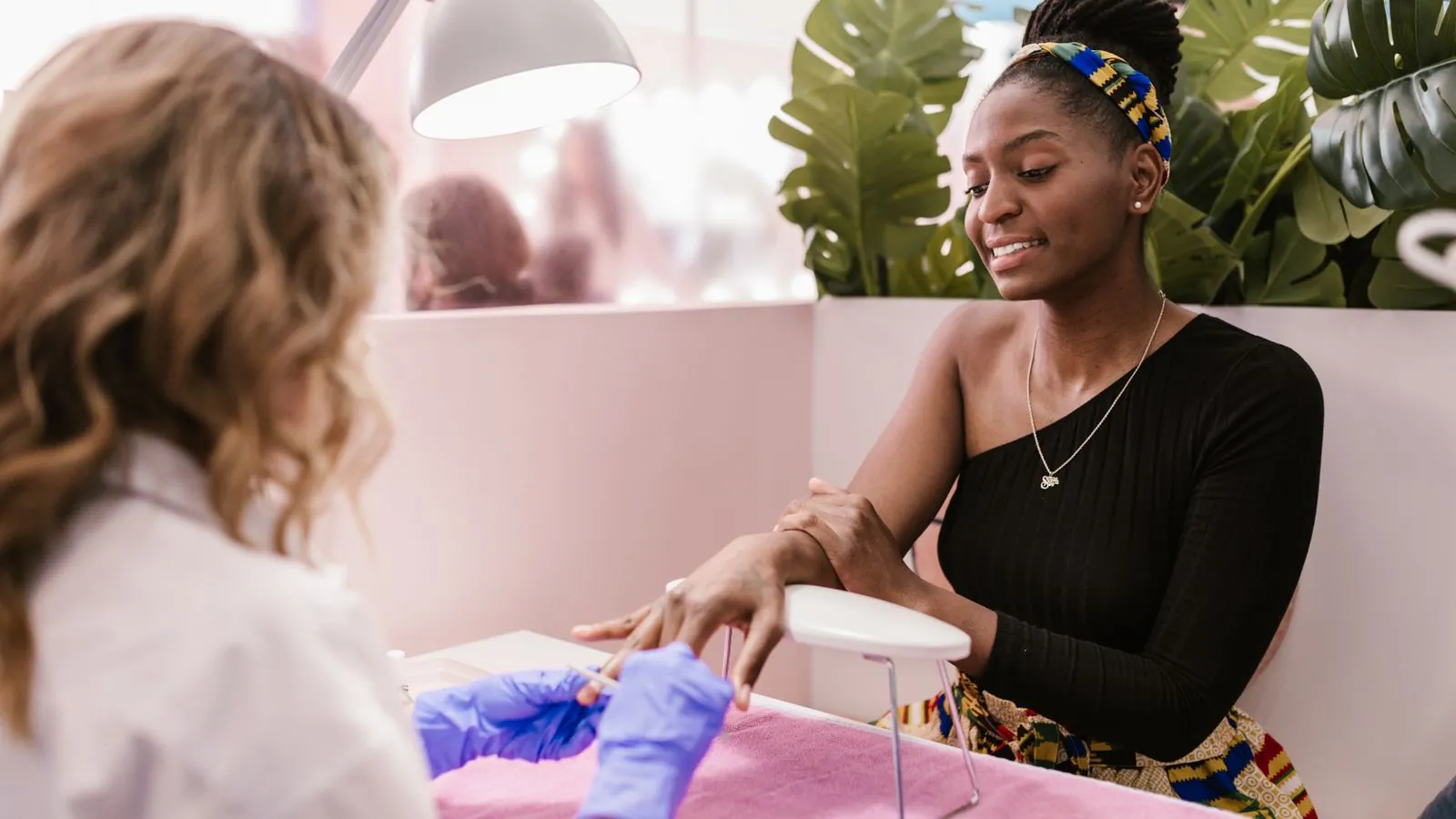
When a woman decides to get her nails done, she doesn't tour the salons in her town. She takes out her phone, types "nail bar" followed by the name of her area, and looks at the list Google shows her. In a few seconds, without even thinking, she has already eliminated half the salons. On what criterion? Not the quality of the set, which she can't judge. Not the technician's talent, whom she doesn't know. She eliminates on the Google reviews: their number, their rating, and above all their freshness.
My name is Léo, I run Pépite Pass. We equip neighbourhood businesses, beauty salons, nail bars, hair salons, restaurants, with simple tools to build customer loyalty and collect Google reviews. I spend my days talking to salon owners, and there is one point that stuns every single one of them when we discuss it: their customers are happy, genuinely happy, but it shows nowhere on Google. The satisfaction exists, it just never turns into a review. And meanwhile, the new customer who is hesitating goes to the competitor, because the competitor has 200 recent reviews.
This article is not a beauty lesson. You know your trade far better than I do, and by a long way. My subject is that precise moment when a stranger chooses between you and the salon next door, on her screen, before she has even pushed a door open. That moment is won or lost on Google, and the good news is that it can be worked on.
🛡️ 1. The customer doesn't choose the best nail bar, she chooses the most reassuring one
You have to understand one thing about the psychology of the beauty customer: she is taking a risk. She is going to hand her nails, her skin or her face to someone she has never met, for a result she will keep for several weeks. A bad set means three weeks of hiding her hands. So before booking, her brain looks for one thing only: reassurance.
And the only proof she has in front of her, at that moment, is your Google reviews. Not your Instagram portfolio, which she assumes is curated. Not your decor, which she won't see until she is on site. The reviews, written by other women like her, who took the same risk before her and came out happy. That, and only that, is what unlocks the booking.
Three dimensions matter in the customer's mind, and in this order:
- The number.Lots of reviews means lots of customers, so a low risk. A salon with 8 reviews is frightening, even at 5 stars, because you tell yourself "those might be her friends".
- The rating. Below 4.5, the customer is wary. Above it, she relaxes. But the rating alone is not enough: a perfect rating on 10 reviews weighs less than a 4.8 on 150.
- Freshness.This is the most underrated criterion. If the latest review is from eight months ago, the customer subconsciously wonders whether the salon is still doing well, whether the team has changed, whether the quality still holds. A review dated yesterday says: "here, it works, right now".
The takeaway: you can be objectively the best nail bar in your town and still lose the customer to a mediocre competitor, simply because its Google profile looks more alive than yours. It is unfair, but it is the reality of choosing online.
🚧 2. The real problem is not satisfaction, it is following through
Here is the paradox I come across in almost every salon. When I ask the owner "are your customers happy?", the answer is always yes, and it is true. In beauty, the satisfaction rate is very high: a customer who leaves with lovely nails is delighted in the moment. So the problem is not satisfaction. The problem is that this satisfaction never crosses the threshold of the written review.
Why? Because between "I'm happy" and "I open Google, I search for the salon, I click the right star, I type out some text", there is a mountain of friction.
The customer leaves the salon, she is thinking about something else, she is already on with her day. The moment of peak satisfaction has passed.
And three days later, when you send her a reminder text, she is happy but the emotion has faded, so she puts it off, so she forgets. 💀
The other barrier is the awkwardness. Many owners simply don't dare to ask. "I feel like I'm begging", "it comes across as pushy", "I'm afraid of bothering the customer when she has just paid". So the request isn't made, or is made half-heartedly, and the customer doesn't feel genuinely invited. The result: the satisfaction stays locked in the customer's head, and your Google profile stays frozen.
So the answer is not to ask more loudly. It is to remove the friction and the awkwardness at the same time. You have to capture the customer at the exact moment she is happy, in the shop, nails still fresh, and make the gesture so simple and so pleasant that she does it without thinking. I laid out the whole mechanics of collecting reviews in this complete guide to getting more Google reviews in 2026, which pairs well with what I'm describing here.
🎡 3. Turning the review request into a fun moment: the wheel
This is where I see a real difference in the salons we work with. Instead of asking for a review, which creates the awkwardness I was talking about, we turn the request into a game. Concretely: at the end of the treatment, while the customer is admiring her nails or the polish is drying, you simply say "here, scan this, you get a chance to win a gift". She scans a QR code sitting on the counter, a prize wheel opens in her browser, she plays, she wins a prize.
As the game plays out, the Google review becomes a natural step. The customer no longer feels she is being asked for a favour: she plays, she has fun, and the review is part of the moment. It changes the dynamic completely.
You are no longer the slightly embarrassed owner who begs, you are the friendly salon that offers a little game at the end of the session. The customer leaves with lovely nails, a gift, and a smile.
👉 And you have one more review.
Three things make this setup particularly well suited to nail bars and beauty salons:
- No app to download.The customer scans the QR with her phone's camera, the wheel opens in the browser, that's it. No account, no password. When your nails are still drying, this is non-negotiable: everything has to fit into a few taps.
- Perfect timing. You capture the customer at peak satisfaction, in the shop, not three days later by text when the emotion has faded. It is the moment she most wants to say good things about you.
- The prize creates a reason to come back. To collect her gift, the customer has to walk back through your door. A scan becomes a visit, and a new customer becomes a returning one. We come back to this in a second, because it may be the most important point.
An important note on honesty, because I am often asked this: the wheel collects no email or phone number from your customers. It is not a data-capture tool. It does two things, and only two: it boosts your Google reviews, and it brings your shop to life with a prize draw. If on top of that you want to build a customer database and follow up with your customers, that is a separate topic (the loyalty card), but the wheel deliberately stays simple and straightforward.
🎁 4. The prize that brings them back: the second visit is worth its weight in gold
In local beauty, everyone focuses on the first visit. We run ads, we polish the Instagram, we work the Google profile to bring a stranger in for the first time. But the first visit is not the point. The real point is the second.
Because a customer who only comes once is worth almost nothing, whereas a customer who gets into the habit of coming every three weeks is worth a small fortune over the year.
The problem with the first visit is that it doesn't create a habit. The customer has tried you, she liked it, but nothing mechanically pushes her to come back to you rather than try somewhere else next time. That is exactly where the wheel's prize does its job: the customer wins something (a free set, a discount on a treatment, a mini-product) she can only collect by coming back. You have just manufactured a concrete reason to see her again.
And that second visit is your golden moment. It is where the customer moves from "I tried it" to "this is my salon". It is there, while she collects her prize, that you can offer to lock in her next appointment straight away. A customer who comes back a second time and leaves with a date in her diary is a regular in the making. The prize cost only a few euros, and it may have won you a customer for two years.
See how the wheel brings your customers back
This "come back to collect" mechanism combines very well with a real loyalty programme over time. I wrote a whole article on customer loyalty in the beauty trades, which I recommend if you want to go further than reviews: the loyalty programme for hairdressers and beauty salons. The wheel attracts and brings them back a first time; loyalty anchors the habit over the long run.
💬 5. Replying to reviews: the half of the job everyone forgets
Collecting reviews is the first half of the game. The second, which many salons neglect entirely, is replying to them. And it matters more than you'd think, for two reasons.
First, Google favours active profiles. An owner who replies to her reviews sends a signal of a lively, attentive salon, which plays into local visibility over time. Second, and above all, your replies are read by future customers. When a stranger reads your reviews before booking, she reads your replies too. A warm reply to a positive review shows that you look after your customers. And a calm, professional reply to a negative review often reassures more than a 5-star review: it proves that, if something goes wrong, you handle it.
The rule I give salons: reply to everything, within a few days, in a real human voice. Thank people by their first name on positive reviews. On a negative review, never justify yourself in the heat of the moment: acknowledge, offer to talk it over, invite them back. I put together a dedicated guide with ready-to-adapt reply examples: how to reply to Google reviews, the good and the bad. It is ten minutes a week, and it turns your profile into a living sales argument rather than a plain list of stars.
📋 6. What a beauty salon's Google profile should show in 2026
Beyond the reviews, your Google profile has become your real shop window, often seen before your Instagram and even before your website. Here is the contrast I see between a profile that converts and a profile that lets customers slip away.
| Profile element | Profile that drives people away | Profile that converts |
|---|---|---|
| Number of reviews | A handful, assumed to be from friends and family | A mass that reassures on the risk |
| Latest review | Several months ago, a profile that looks dead | This week, a salon running at full tilt |
| Replies to reviews | None, an absent owner | All of them, in a real voice |
| Photos | Two blurry photos from three years ago | Recent sets, the salon, the atmosphere |
| Hours and booking | Wrong hours, no link to book | Up to date, with a clear path to book |
None of these elements is complicated. They are simple gestures, but they call for regular discipline. The only one that truly depends on a system is the flow of recent reviews: photos and hours you sort out once; fresh reviews need a mechanism that produces them week after week, without you having to think about it. That is exactly the wheel's job.
📅 7. The full scenario in a day at a nail bar
To make all this concrete, here is what a typical day looks like in a nail bar that has put the system in place. Nothing theoretical, it's the sequence I see on the ground.
- 10am.First customer, gel set. Flawless treatment, she loves it. At the end, while you tidy up, you hand her the QR: "try to win a little gift". She scans, plays, leaves an enthusiastic review, wins a discount on her next hand treatment.
- 2pm.A new customer, who came because a friend told her about you. She checked your profile before coming and saw this morning's review, brand new. It reassured her. She plays the wheel too on her way out.
- Two weeks later. The 10am customer comes back to collect her discount. You take the chance to book her next appointment. She has just become a regular, without you spending a thing on ads.
- That evening, at home.Ten minutes to reply to the day's two reviews, by their first name. Your profile has never looked so alive. ✨
See the loop? Every happy customer feeds your Google profile, which draws in the next customer, who in turn leaves a review and comes back for her prize. It is a machine that runs itself, and it doesn't rely on an ad budget: it relies on the satisfaction you already produce every single day, which we finally make visible.
🔥 8. The mistakes I see most often in the beauty trade
A few classic traps I come across in beauty salons and nail bars, and which cost customers without anyone noticing:
Mistake no. 1: relying on Instagram to bring in strangers. Instagram keeps the link alive with those who already follow you, which is valuable. But the customer who doesn't know you isn't looking for you on Instagram, she's looking for you on Google Maps. Your Google profile is your first salesperson, your Instagram is your second. Putting everything into Insta and neglecting Google is like polishing the window at the back of the shop while the one on the street stays empty.
Mistake no. 2: asking for the review by text three days later. The reminder text arrives too late, when the emotion has faded and the customer has moved on. The right moment is in the shop, nails fresh, a smile on her face. You capture it there, or you don't capture it at all.
Mistake no. 3: letting the profile sleep. A profile with no new review for months, no replies, with old photos, sends the signal of a salon just ticking over. Even if you are actually thriving, your profile says the opposite. And the customer believes the profile, not the reality, because the profile is all she sees.
Mistake no. 4: confusing collecting reviews with buying reviews. Buying fake reviews, or demanding 5 stars to win a prize, is banned and risky for your profile. Inviting a real customer to share her honest experience, while making the gesture easy, is allowed and is exactly what a well-configured wheel does. The difference is clear: you don't pay for a rating, you bring your shop to life and leave the customer free to give her own opinion.
🎯 9. If I had to sum it up in one sentence
Your competitor doesn't win because she does nails better than you. She wins because at the moment the new customer chooses, on her screen, her Google profile reassures more than yours: more reviews, more recent, replies, a living profile. The quality of your work, the customer only discovers after she has chosen. The choice itself is made before, on social proof.
The good news is that you already have the raw material: happy customers, every day. All you're missing is a system to turn that satisfaction into visible reviews, without awkwardness and without hounding anyone. An end-of-treatment activation that captures the customer at the right moment, gives her a reason to come back, and feeds your profile continuously. That is exactly what the Pépite Pass prize wheel does, and you can test it free, with no bank card, on your real customers.
The mechanism of "bring the shop to life to turn satisfaction into Google reviews" is not unique to beauty: I told the story for another trade in this article about bubble tea, and the principle stays the same everywhere the customer chooses on Google before pushing the door open.
If you'd like us to look at your case concretely, your profile, your local competition, what's blocking things, write to me on WhatsApp at 06 03 90 27 83 or request a demo of the wheel. I won't sell you a miracle, I'll tell you what I see working at the beauty salons and nail bars we support. It's free, no commitment, and it will spare you from carrying on handing your new customers to the competitor.