You are going to spend weeks comparing the price of a wood-fired oven against an electric one, negotiating your lease premium down to the last thousand euros, poring over every renovation quote. That is normal, it is serious.
Then, on opening day, you are going to plug in Uber Eats and let a platform take 30% on part of your orders, without flinching. With a net margin that hovers around 15%, that maths does not add up.
That is what this article is about: the real budget of a pizzeria in 2026, and the invisible mistake that eats your net result.
My name is Léo, I run Pépite Pass. We operate digital menus, commission-free click & collect, Apple Wallet and Google Wallet loyalty cards for restaurants and pizzerias all over France. I am not going to teach you how to stretch a dough: there are pizzaiolos far better than me for that. My subject is the economics of your business: how much you need to put in to open, how much is left in your pocket at the end of the month, and where the money you think you are making actually goes.
💸 1. The real budget of a pizzeria: from single to sevenfold
The first truth that surprises future openers is the scale of the gap. Depending on the format you choose, the opening budget varies by a factor of seven. A pizzeria is not one project, it is three very different projects that go by the same name.
| Format | Indicative opening budget | What it involves |
|---|---|---|
| Van / food truck | €40,000 to €70,000 | Vehicle + on-board oven, few fixed costs, mobile location |
| Takeaway kiosk | €60,000 to €120,000 | Small premises, no dining room, everything on takeaway and collection |
| Pizzeria with dining room | €150,000 to €280,000 | Renovations, lease premium, dining room, terrace, larger team |
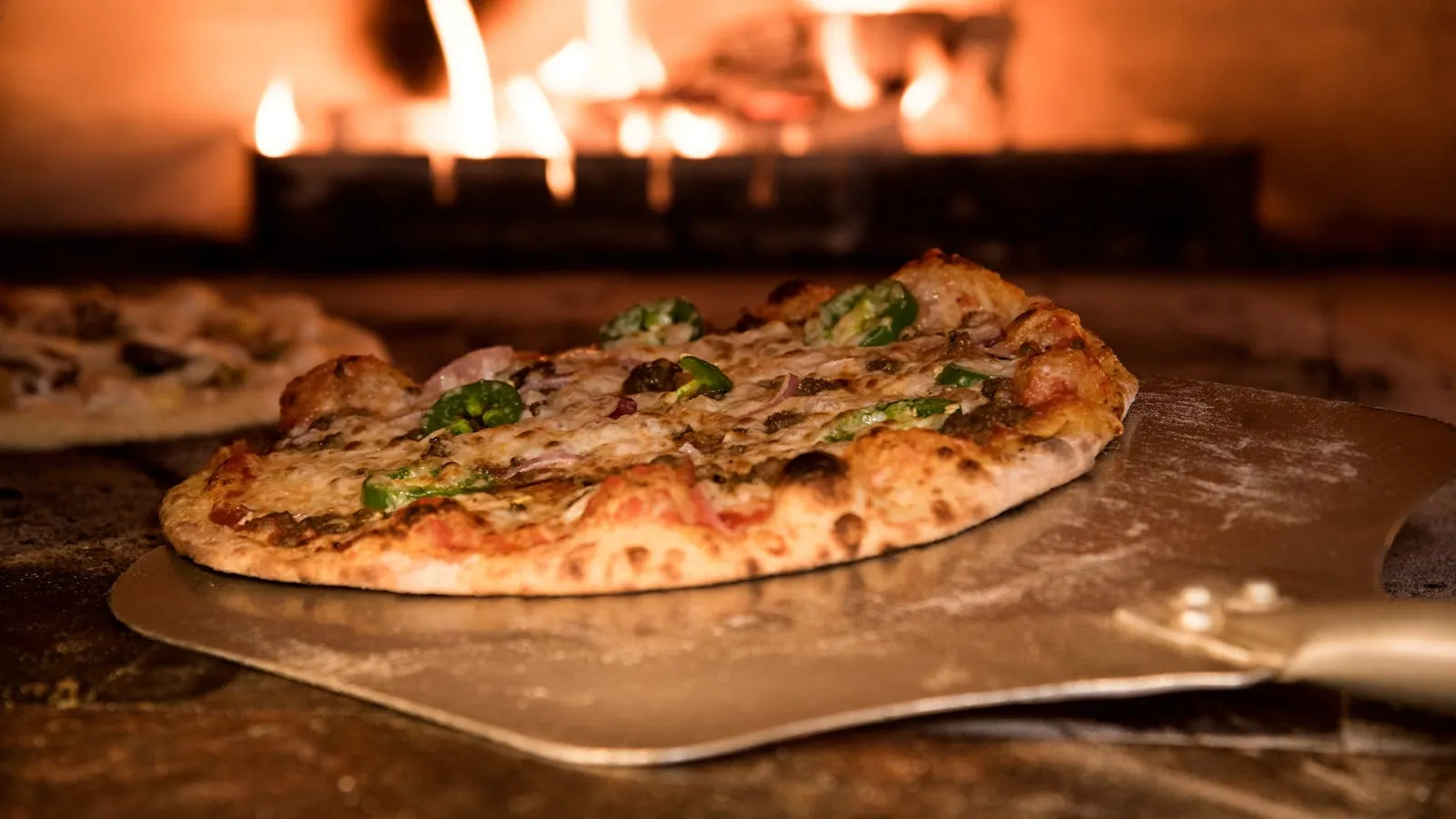
In every case, the big cost lines come back: the oven (from €6,000 for an entry-level electric to €30,000 for a masonry wood-fired oven), the fit-out and renovations, the refrigeration equipment (cold room, dough mixer, roller), the lease premium or key money if you take over premises, and the opening stock.
But the line almost everyone underestimates is the starting cash reserve: the 3 to 6 months of fixed costs you need to be able to pay before the business gets going. It is that cushion that decides whether you survive the first quiet winter or go under in February.
Let me make one thing clear straight away, because it matters for what follows: a pizzeria is a business where a huge share of the volume is done as takeaway or delivery. Depending on the outfit, it is often the majority of turnover. That means the way you handle your remote orders is not a technical detail: it is the heart of your business model.
📊 2. Pizza: royal gross margin, tightrope net margin
Here is the figure that makes future pizzaiolos' eyes light up: the gross margin. On a pizza sold at €12, your food cost (dough, sauce, mozzarella, topping, box) is around €3 to €4. So you are at 60 to 75% gross margin. On paper, it is magnificent. Far better than a traditional restaurant.
And then reality arrives. Out of that €12, you have to pay:
- the rent and the premises charges;
- the wages, and above all the social charges that come with them;
- the energy (an oven running consumes a lot);
- the depreciation of your initial investment;
- the insurance, the accountancy, the subscriptions, the unexpected costs.
Once everything is paid, the net margin of a pizzeria commonly hovers around 10 to 15%. On €100 taken in, you are left with €10 to €15. It is the nature of the trade, it is not a disaster in itself.
But it has a fearsome consequence: with a net margin this thin, the slightest margin leak does disproportionate damage. A leak of 5 points on your gross margin is a third of your net margin gone. Keep that figure in mind, because we are getting to the heart of the problem.
🔥 3. The 30% mistake: letting the platforms siphon off your margin
You have budgeted to the letter. You know your net margin is 15%. And on opening day, you plug in Uber Eats and Deliveroo "because everyone does it". On delivery, these platforms commonly take 25 to 30%of every order's value. Let us do the maths, because it is brutal.
| Order of €30 of pizzas | Via platform (30%) | Via your click & collect (0%) |
|---|---|---|
| Taken from customer | €30.00 | €30.00 |
| Food cost (~30%) | - €9.00 | - €9.00 |
| Platform commission | - €9.00 | €0.00 |
| Margin left before fixed costs | €12.00 | €21.00 |
| Allocated fixed costs (~€9) | - €9.00 | - €9.00 |
| Final net margin | ≈ €3.00 | ≈ €12.00 |
Read that last line carefully. The same order leaves you €3 via the platform against €12 via your own channel.
👉 That is four times more.
The €9 commission does not come from nowhere: it comes straight out of your net margin, the one that pays your salary and your taxes. On some smaller orders or ones heavier on ingredients (a special pizza, an extra drink), it can even happen that the order placed through a platform makes you lose money. 💸
You work, your oven runs, your pizzaiolo is busy, and at the end of it you pay for the right to serve a customer.
Now multiply that gap by your volume. A pizzeria doing 1,000 orders a month via platform at a €30 average basket leaves about €9,000 of commission on the table every month. Even if only half those orders could shift to your own channel, you are talking about several thousand euros reclaimed a month. For many pizzerias, that is the entire net result of the year.
⚠️ 4. Why commission is even worse than it looks
The maths above only shows the financial leak. But dependence on the platforms costs you three other things, more insidious, that appear on no invoice.
- You lose the customer relationship.On a marketplace, the customer is not yours: they are the platform's. You have neither their name, nor their contact, nor any way to bring them back directly. You pay 30% to rent a customer you may never see again.
- You are a line in a catalogue. On the app screen, your pizzeria is displayed next to 15 competitors, sorted by an algorithm you do not control. The customer compares prices, not brands. You are no longer a brand, you are an interchangeable option.
- You fund your own dependence. The more volume you do via the platform, the more you get used to that volume, the more unthinkable it becomes to cut it off. After a year, 40% of your turnover runs through a channel that takes 30%, and you can no longer stop it without shaking. That is exactly the trap.
I have set out elsewhere how much a customer you lose or fail to bring back really costs: this calculation of the real cost of a lost customer in the restaurant trade applies word for word to pizzerias. And on the deeper reasons restaurants close, I have written the three marketing mistakes that shut a restaurant down: blind dependence on the platforms is clearly one of them.
✅ 5. The solution: your own click & collect at 0% commission
The good news is that pizza is the ideal product for taking back control. Why? Because customers are already used to coming to collect their pizza. The reflex "I order, I come and pick it up" has always existed in this trade. You do not have to create a new behaviour, you just have to digitise it properly.
The scenario I see working at the pizzerias we support: the customer scans a QR code on your counter, your window or your card, or clicks your link from your Google Business Profile or Instagram. They land on your up-to-date menu, with photos and prices, choose their pizzas, pay online.
The order appears directly on your kitchen tablet. You start the bake at the right moment, the customer comes to collect at the agreed time.
👉 No queue, no badly noted phone call, no commission. The money arrives directly with you.
On cost, the logic completely reverses compared with a platform. Instead of paying a percentage that climbs with your volume (the more you succeed, the more you pay), you pay a fixed monthly subscription. The Pépite Pass digital menu costs the equivalent of a coffee a day, with a free trial, no card and no commitment. Do the sum: if a single evening of orders on your own click & collect saves you more commission than the month's subscription, the rest of the month is net bonus. For a pizzeria, that threshold is crossed within a few days.
See the digital menu + 0% commission click & collect
And it is not just an order-taking tool. The digital menu is four things on a single page: your living menu ✨ (editable in 30 seconds, updated instantly, automatic translation for tourists), your public storefront that acts as a mini official site with opening hours and photos, the click & collect at 0% commission, and table booking in two taps if you have a dining room. The physical QR code is generated automatically. I have written a full guide on this: the QR code digital menu for restaurants. For a pizzeria, the game-changing piece is clearly the click & collect, but the multilingual menu earns its keep from the very first tourist who walks in.
🤔 6. Should you quit the platforms overnight?
No, and I would be dishonest to tell you otherwise. At launch, a platform can bring you real visibility while your neighbourhood reputation builds. The aim is not to cut everything at once, it is to gradually take back control. Here is the concrete strategy I recommend.
- Treat the platform as a discovery channel, not as your business. It gets you known. It must not own you.
- Slip your QR code into every order that goes out.On the box, the receipt, the bag. Simple message: "Next time, order directly here, it is faster and it helps us." Every customer moved onto your channel is a customer you no longer pay 30% on for life.
- Give a real reason to come back directly.A digital loyalty card in the customer's Wallet, for example, that rewards orders placed with you and not via the platform. The customer who has your card in their phone and three orders on the counter has no reason left to go back through the app that costs them time and costs you your margin.
- Measure the shift. Track each month the share of your volume that goes direct against the share that goes through a platform. The goal: the direct curve rises, and dependence falls.
The idea is not ideological, it is arithmetic. Every point of volume brought back to your direct channel is 30% of margin reclaimed on that volume. In a trade at 15% net margin, that is colossal.
🍕 7. How many pizzas a day to hold on: the break-even calculation
Back to concrete matters. The question every future opener asks: how many pizzas do you need to sell per day not to sink? There is no universal number, but there is a simple method to find yours.
Take your monthly fixed costs: rent, loaded wages, energy, subscriptions, loan repayment. Say €12,000 a month for a modest neighbourhood pizzeria. Take your average gross margin per pizza: if you sell at €12 with €4 of food cost, that is €8. Divide: 12,000 / 8 = 1,500 pizzas a month just to cover your fixed costs. Over 25 days worked, that is 60 pizzas a day before earning a single euro. Everything above that threshold becomes net margin.
Now connect that to the commission. If part of those 60 pizzas goes through a platform that cuts your gross margin by 30%, your margin per pizza on those orders drops from €8 to about €5. The result: your threshold rises. You no longer need to sell 60 pizzas a day, but 70, 75, maybe more, just to cover your fixed costs. The commission does not only nibble at your profit: it pushes your break-even point upwards and makes every day harder to close out. Taking back control of your orders therefore also means lowering the number of pizzas you have to sell to survive.
❌ 8. The other mistakes that sink a pizzeria at the start
Commission is the most expensive mistake, but it is not alone. Here are the ones I see coming back most often at the pizzerias struggling by month six.
Underestimating the starting cash reserve. You put everything into the oven and the decor, and you have nothing left to hold on through the first three quiet months. It is the number one cause of early closure. Always keep a cushion of several months of costs.
A menu that is too long. Thirty pizzas on the menu is thirty ingredients to store, manage and throw away when they go off. A short, clean menu means fewer losses, a faster kitchen, and a customer who chooses more quickly. On your digital menu, you can also hide a sold-out pizza in 30 seconds instead of crossing out a chalkboard with a marker.
Doing nothing to bring the customer back. A pizzeria lives on repetition: the Friday-night customer, the Sunday family. If you put no return mechanism in place, you start from zero on every order. Smooth online ordering on your own channel, paired with a loyalty card in the Wallet, turns a one-off purchase into a habit. It is cheaper and far more profitable than re-buying the same customer every month through ads or the platform.
Neglecting the Google Business Profile and reviews.When someone types "pizza near me" on a Friday at 7pm, it is your Google rating that decides. Politely ask your happy customers for reviews from opening day, and look after your profile. It is free and it is your best local advertising.
🎯 9. If I had to sum it up in one sentence
Opening a pizzeria is a project where you will watch every euro of investment. Be just as rigorous about the money going out after opening as about the money going out before. Your oven, your renovations, your lease premium: you pay them once. The 30% commission on your orders, you pay it on every pizza, every day, forever. That is where the difference is decided between a pizzeria that lives off its work and a pizzeria that works for the platforms.
With a net margin of 15%, you simply cannot afford to give 30% of your orders to a middleman. Your own click & collect at 0% commission is not a luxury, it is the lever that separates the viable from the unviable. Pizza is the perfect product for it: your customers are already ready to come and collect it, you just have to offer them a direct, clean and fast channel.
If you are putting together your pizzeria project, or if you already have one that is maxed out on Uber Eats and Deliveroo, message me on WhatsApp at 06 03 90 27 83. We will lay out your figures together, and I will tell you honestly what a digital menu with click & collect could win you back. You can also see a demo in two minutes. No pitch, just the concrete. Good luck with the opening, and above all: keep your margin with you. 💪