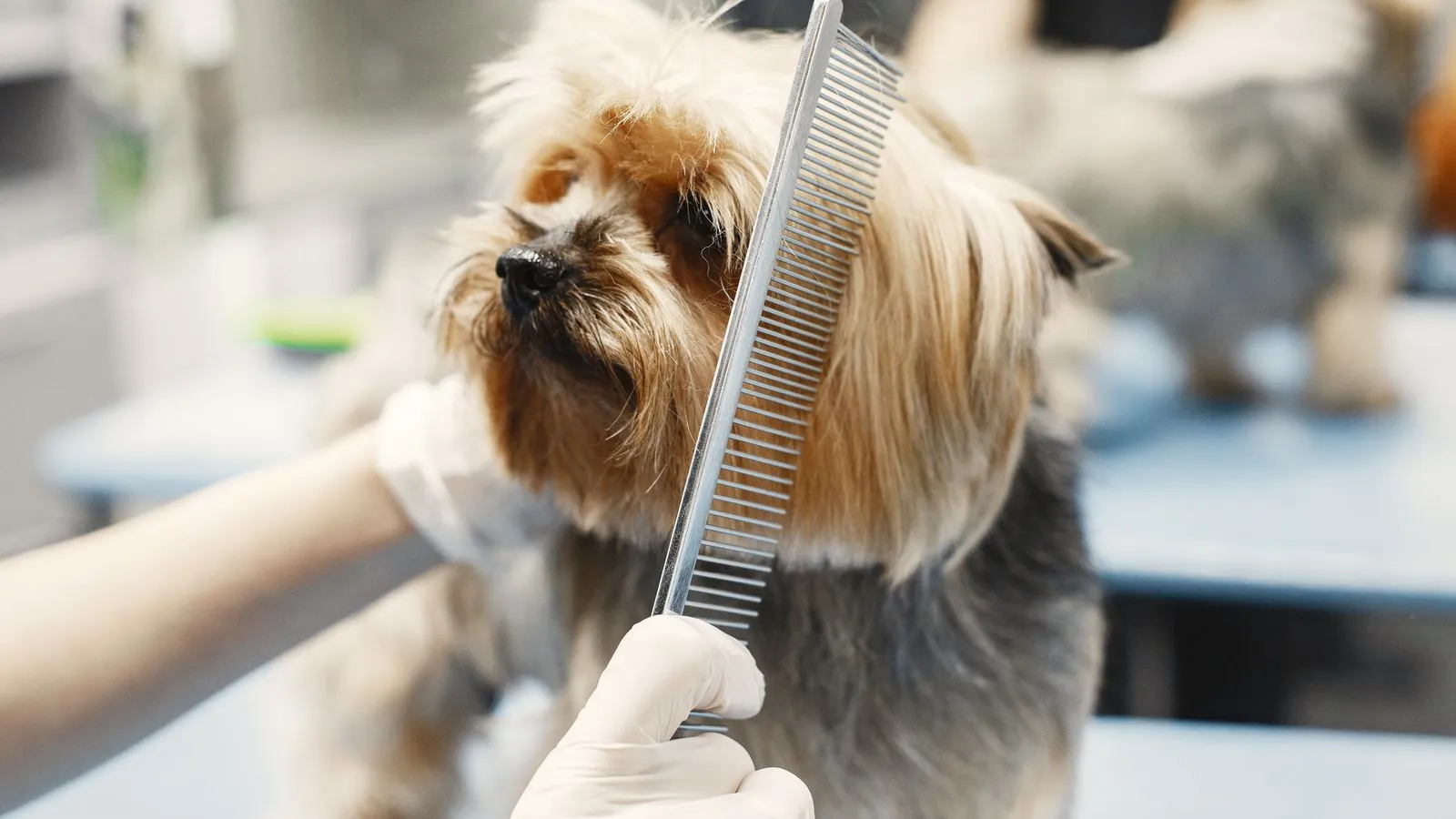
Grooming is a rare trade: the customer's need comes back on its own, like clockwork. A regularly groomed dog needs to pass back through the groomer's hands every 6 to 8 weeks, otherwise the coat mats, tangles, and ends up as an impossible-to-brush-out felt.
You don't even have to create the demand: biology creates it for you. And yet most of the salons I come across leave that recurrence resting entirely on the owner's memory.
💸 That is, quite literally, leaving money on the table with every cycle.
My name is Léo, and I run Pépite Pass. We operate loyalty cards in Apple Wallet and Google Wallet for local businesses all over France: restaurants, beauty salons, pet shops, and more and more dog grooming salons.
And grooming is a textbook case, because it is one of the very few trades where the ideal return frequency is almost mathematical. The problem is never the need: it is always the same, it is that on the salon's side nobody owns that need.
This article isn't a technical guide on scissor work or picking your hydraulic table: I am not a groomer, and you know your trade a thousand times better than I do. My subject is the business side: how to move from a relationship where you wait for the owner to call back, to one where you are the one driving the recurrence. And on that, I have some concrete things to show you.
🧠 1. The recurrence already exists, but it lives in the wrong head
Let's state the problem clearly. In most service trades, you have to manufacturea reason to come back. The hairdresser, the restaurant, the clothes shop: they fight to reinstall a frequency into the customer's life.
You groomers are lucky: the coat grows back, full stop. The need returns all by itself.
Except there is a nasty catch. That recurrence really does exist, but it lives in the owner's head, not in your system. And the owner's head is a terribly unreliable place.
Between work, the kids, the holidays and the fifty other things to think about, "I must rebook the dog" gets crushed week after week. Until the day the coat is so tangled that the owner feels guilty, puts it off again out of shame, and ends up spacing out their visits.
A very concrete result: a customer who should have come 8 times in the year only came 5. You did nothing wrong. Your service was perfect.
But you lost 3 obvious appointments, simply because nobody on the salon's side followed up. On a client base of 150 regular dogs, do the maths on what that adds up to over a year.
It is the most discreet and most costly leak in the trade.
⏰ 2. Why grooming gets forgotten more than other appointments
You might think: "but everyone forgets their appointments". True, but grooming stacks up two specific weaknesses that make it a champion of forgetting.
- No immediate pain.When you have toothache, you call the dentist: the pain pushes you. A dog's regrowing coat, on the other hand, hurts nobody at first. It is a slow, gradual discomfort that people tolerate for far too long. Nothing forces the owner to act at any given moment.
- A long cycle, so easy to put off.6 to 8 weeks is long enough to tell yourself "next week" ten times in a row without feeling guilty. A weekly thing, you anchor it. A bi-monthly thing, you lose sight of it.
These two mechanisms combine to produce exactly the worst-case scenario: a real, certain need that comes back for sure, but that nothing triggers at the right moment. The owner isn't a bad customer. They are just human. Your job, if you want to stabilise your revenue, is to stop relying on their memory and to become the one who follows up at exactly the right point in the cycle.
🎯 3. The turnaround: stop waiting, start steering
The whole challenge comes down to this shift: moving from a passive relationship to a steered one. In a passive relationship, your flow of appointments depends on the motivation and memory of busy people. In a steered relationship, it is your system that gets back in touch, at the right moment, without you having to think about it every morning.
To steer, you need three building blocks, and they are simple:
- Identify each customer reliably.As long as your customers are names scribbled in a notebook, you can't automate anything. You need a stable identifier per owner (and ideally per pet), and a channel to reach them.
- Schedule the reminder on the cycle. From the date of the last visit, you know when the next one should fall. The reminder should fire within that window, not at random.
- Reward regularity. To give the owner a rational reason to stay with you and not skip a cycle, a visible loyalty mechanic (a free treatment on the Nth grooming) works wonders.
The good news is that these three building blocks can fit into a single tool. That is exactly what a digital loyalty card in the phone's Wallet does: it identifies the customer, it opens a free reminder channel, and it makes regularity tangible. Let's look at how, concretely.
📱 4. The digital card, the centrepiece for a groomer
When you say "loyalty card", many groomers picture the cardboard stamp card, lost three times out of four at the bottom of a bag. Forget that. I'm talking about a card native to Apple Wallet and Google Wallet, in other words in the cards app that is already installed on every phone, next to boarding passes and train tickets.
In practice, here is how it goes at the salon. The owner arrives, leaves with their freshly groomed dog, and when it's time to pay, your till poster invites them to add their card. They scan a QR code (or you send them a link by text), and in one tap the card is in their phone.
No app to download, no account to create, no password.
👉 It is zero friction, and that is decisive: a card you adopt in 5 seconds is a card people actually adopt.
From there, you hold all three building blocks at once:
- Identification. Each card is a known customer in your console: you know who came, when, how many times. No more illegible notebook.
- The reminder channel.You can send push notifications straight to the owner's lock screen, free and with no limit. No cost per message, unlike a text.
- The reward. Take your pick: stamps (like the paper card, but in the phone), points, or a cashback pot. After X groomings, the free treatment or service. The owner sees their progress at every visit, which pushes them not to break the streak.
And that last point is no small thing: it is what's known as the endowed progress effect. As soon as a customer has a few stamps on their card, their brain whispers that "it would be a shame not to finish". It has been documented in behavioural psychology for years, and it works as well on a coffee as on a grooming. If you want to dig into the various possible mechanics, I've broken down the loyalty programme mechanics that really work: points, stamps, cashback, and when to choose which.
The fact that all of this lives in the Wallet rather than in a separate app is a game changer. To understand why "no app" is an advantage and not a compromise, have a look at why a loyalty card with no app converts far better.
🔔 5. The push reminder: the right message, at the right point in the cycle
This is the heart of the matter for a groomer. Once the owner has their card in the Wallet, you have a direct, free and unlimited reminder channel. And you use that channel by lining it up with the regrowth cycle.
The principle is simple: from the date of the last visit, you roughly know when the next one is due. As you approach that window, you send a push. Not a cold, generic push, but a message that talks about the pet:
- "Biscuit's coat must be starting to grow back. Shall we hold a slot for you this week?"
- "It's coming up to 7 weeks for Rex: let's avoid the knots, shall we book?"
- "Happy birthday to Bella! A little treatment on us if you come by this month."
The difference between a salon that follows up and one that waits is right there. The owner who gets this message at the right moment thinks "oh yes, that's right" and rebooks straight away. Without that message, they'd have thought of it two weeks later, or not at all.
And the detail that makes all the economic difference: these Wallet push notifications are free and unlimited, whereas a text costs you a few cents each time you send one. So you can follow up with your whole base every cycle without watching a counter. I explained how this channel works and how powerful it is in detail in this article on the Wallet push notifications that bring customers back at no cost: the trade changes, the mechanism is exactly the same.
See how to schedule cycle reminders for your salon
An important point of balance: reminding is not pestering. One push per cycle, timed to the right moment, is expected and useful. Three promo pushes a week guarantees you'll get removed. 💀 Stick to the service mindset: you're doing the owner a favour by sparing them a matted dog, you aren't selling them something they don't need. That is the whole tact of the trade, and it is what makes a customer accept your reminders over the long run.
💤 6. Winning back dormant customers (the ones who drifted off without saying so)
There is a category of customers that almost no salon wins back, simply because it doesn't even know they've vanished: the dormant ones. These are the owners who used to come regularly, then skipped a cycle, then two, and dropped off the radar without ever saying goodbye. They aren't upset. They simply forgot, or put it off one time too many.
With tracking tied to the digital card, you see these customers at a glance in your console: "here are the owners whose pet hasn't come back for far longer than its usual cycle". The data does the sorting for you. Then a warm follow-up, centred on the pet and not on your revenue, brings a good share of them back:
"It's been a while since we've seen Biscuit! His coat must be starting to knot up. Shall we hold a slot for him this week, with a little treatment on us for his return?"
You talk about the dog, you offer a small gesture, you make the appointment easy to rebook. The dormant customer who gets that rarely says no. Once again: they hadn't left, they had simply lost the thread. Your role is to catch them before a competitor does it in your place.
📊 7. Beyond the reminder: truly knowing your customer base
The benefit people most underestimate isn't the reminder, it is the data it hands you along the way. When every customer has a card, you stop flying blind:
- You see your best customers: the ones who come most regularly, who deserve special attention, for whom you can save your most convenient slots.
- You measure your real return rate: how many dogs seen in January came back within their cycle? That is the true health indicator of your salon, far more than today's takings.
- You spot the cycles that are stretching out before a customer drops off entirely, and you act while there is still time.
This cold read of your customer base is what separates a salon that endures its flow from one that builds it. You personalise the card with your colours, your logo, your photos: for the customer, it is your salon in their pocket ✨, not a generic tool. And at Pépite Pass there are no tiers: whether you track 80 or 800 dogs, it is the same price, with no cost per customer.
⚠️ 8. The mistakes that drive recurring appointments away
To finish, the traps I see coming up most often in salons that struggle to stabilise their recurrence.
Mistake #1: relying on the paper card. It gets lost, forgotten, never taken out, and above all it gives you no data and no follow-up channel. It is a scrap of cardboard that teaches you nothing about your customers. At a time when every owner has their phone in hand when they pay, it is a tool of the past.
Mistake #2: waiting for the customer to call back. This is the founding mistake, the one all the others flow from. As long as recurrence rests on the owner's memory, you leave your revenue to chance. Taking the initiative on contact is the move that changes everything.
Mistake #3: doing nothing between two visits.Six weeks of total silence is six weeks during which a competitor can win your customer over with a simple offer. A useful push, a well-placed reminder, a note for the dog's birthday: you stay present without being heavy-handed, and you close the door on the competition.
Mistake #4: neglecting your online reputation. Reminders keep the customers you already have loyal, but your Google Business Profile brings in new ones. Asking a happy owner for a review, at the right moment, is something you work at too. On this front, the approaches that work in other local trades carry across: see for example how a beauty salon turns its clients into Google reviews, or how a shop converts its footfall into reviews. The levers are the same for a dog grooming salon.
✅ 9. If I had to sum up
You have an advantage almost nobody else has: your customer's need comes back on its own, at an almost mathematical interval. The only problem is that this recurrence is carried by the owner's memory, the least reliable place in the world. Take it back. Put it into your system rather than into their head.
In concrete terms, it comes down to three moves: identify each customer with a digital card and no app, schedule a free push reminder lined up with each pet's regrowth cycle, and reward regularity to anchor the habit. All three fit into a single tool, it sets up in a few days, and it costs less than the handful of recurring appointments you lose every month for want of following up.
If you run a salon and you'd like to talk through your specific case, message me on WhatsApp at 06 03 90 27 83. I won't sell you a miracle solution: I'll tell you honestly what I see working in the businesses we support. You can also see a demo of the digital loyalty card to get a concrete idea. And above all, keep the essential in mind: the coat grows back anyway. The only question is whether it is you who follows up, or the silence.